Silent Era to Early Sound: Cinema as Mass Ritual
Real Reel Talk: Why Nostalgia Matters Series
Scene One: The Flicker of a New Ritual
Picture it: The year is 1917. There’s no Netflix, no TikTok, no endless scroll. Instead, on a Saturday night, the big event is a trip to the local nickelodeon. Maybe you’re a recent immigrant, your English shaky, or maybe you’re a farm kid seeing downtown’s electric lights for the first time. It doesn’t matter. The moment the lights go down and the flicker starts, you’re part of something bigger: a gathering, a ritual, a brand-new public language.
Silent films weren’t just entertainment, they were the glue binding together a fractured, rapidly changing America.
The Universal Language of Silence
Silent cinema’s greatest trick wasn’t supernatural, though. If we're being honest, some of those early special effects are still more convincing than a lot of modern CGI. The real magic was universality. Through expressive acting and visual storytelling, silent films translated emotion and meaning across every barrier, be it class, language, gender, age, or literacy.
Expressive Acting: No sound? No problem. Faces did the talking. Gestures became grammar. A Buster Keaton eyebrow-raise or a Lillian Gish teardrop could break your heart in any language.
Visual Narrative: Directors like D.W. Griffith didn’t just string images together. They invented the grammar of film. Cross-cutting, close-ups, chase sequences, these weren’t just tricks, they were the new syntax of a visual world.
A century before “going viral” was a thing, movies were the original memes. Everyone saw the same images, laughed at the same pratfalls, and gasped at the same cliffhangers. Suddenly, you didn’t need to read or speak English to be in on the joke, the tragedy, or the horror.
Moviegoing as Civic Spectacle
This wasn’t just about what was on screen. It was about how people watched. Early audiences didn’t sit in reverent silence. They cheered, jeered, sang along with organists, and debated plot twists on the walk home. Nickelodeons, matinees, and newsreels turned moviegoing into a social event, a civic ritual as essential as church, the baseball game, or the corner bar.
When films like The Birth of a Nation (problematic as it is) or The Jazz Singer hit theaters, they didn’t just create “buzz,” they set the whole country talking. Parlor conversations, schoolyards, and city parks all became extensions of the movie theater. Audiences were different than the “users” of today consuming stories. These audiences were shaping shared meaning around them.
Chaplin, Griffith, and the Birth of Modern Myth
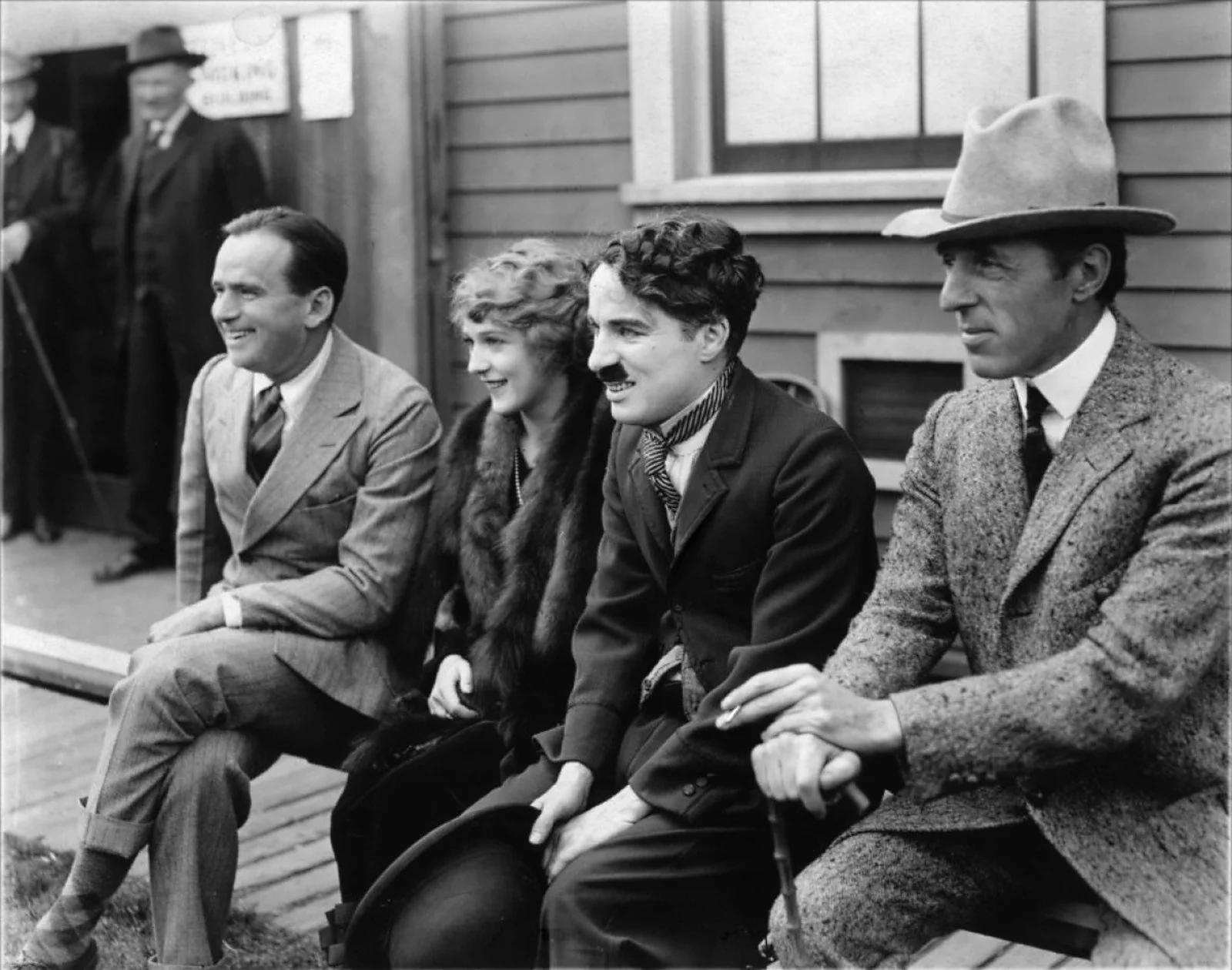
Douglas Fairbanks, Mary Pickford, Charlie Chaplin and D.W. Griffith on the day they formed United Artists (February 5, 1919)
D.W. Griffith: However contested his legacy is, Griffith’s technical innovation, cross-cutting, the close-up, and parallel action gave movies their narrative power. He made the camera an active storyteller and turned the audience into collaborators in meaning.
Charlie Chaplin: The first true global movie star. His Little Tramp persona was as recognizable in Paris as in Peoria. Chaplin’s comedy was universal, his pathos immediate. He proved that a bowler hat and a waddle could unite the world in laughter, and a little bit of shared sorrow.
The Jazz Singer and the Sound Revolution
Then, 1927: Enter The Jazz Singer. It wasn’t the first “talkie,” there were a few shorts that came before, but it was the first to hit like an earthquake. The introduction of sound upended the rules of stardom and modernity. Actors who’d been legends in silence faded out, and new voices became the faces of the future.
Celebrity Redefined: Now, it wasn’t enough to look the part, you had to sound it, too. Movie stars became voices in our heads as well as faces on the screen.
Modernity Accelerated: Sound films sped up the pace of change. Suddenly, movies could sell you music, slang, and style as fast as the world itself was changing.
Generational Impact: From Parlor Talk to “Greatest Generation” Myths
For early 20th-century audiences, movies were more than just a diversion. They were a way to process modernity, migration, war, and upheaval. The stories and stars of silent and early sound cinema helped form the shared cultural vocabulary later associated with what would be mythologized as “the Greatest Generation.” Shared cinematic memory gave diverse Americans a common ground long before the internet, or even radio, could.
Parlor Talk: Everyone had an opinion about the latest picture or star.
Civic Ritual: Moviegoing was a rite of passage, a weekly tradition, a family affair.
Collective Memory: These early films seeded the stories that would echo in American culture for decades.
Why It Matters Now
Silent and early sound cinema show us that nostalgia isn’t just about looking back fondly at old movies. It’s about understanding how those communal experiences built the very idea of “us.” When we watch a Chaplin short today, we’re not just enjoying slapstick, we’re tapping into a ritual that shaped generations.
As sound took hold and the studio system consolidated power, cinema’s communal ritual continued to expand. The mythmaking machinery became more polished, deliberate, and national in scope.
Conclusion: The Ritual Evolves
The nickelodeon is gone. The organist has fallen silent. The shared gasp in a darkened theater competes now with streaming queues and second screens.
Yet, the impulse that built early cinema, that enduring desire to gather and witness together, has lived on.
It has simply become a bit harder to find.
That’s why nostalgia matters, because it reminds us of what communal storytelling once felt like. Silent and early sound cinema built these rituals, giving a fractured nation a shared set of images, myths, and memories.
When we revisit those films today, we’re both watching history and reconnecting with the origins of “us” as theater-goers.
What to Watch
Casablanca (1942)
The gold standard for mythmaking, national identity, and the moral ambiguity of war.
Gone with the Wind (1939)
Hollywood spectacle, Southern mythology, and the power (and peril) of nostalgia.
The Wizard of Oz (1939)
American optimism and fantasy at its most Technicolor.
Mr. Smith Goes to Washington (1939)
Populism, idealism, and the invention of the “everyman” hero.
Where to Watch
Casablanca and The Wizard of Oz are frequently available on HBO and TCM’s streaming app.
Gone with the Wind can often be found on HBO, but check for content advisories, context is everything. Warner Bros. also recently announced a new 4K Blu-ray edition set to drop this fall.
Mr. Smith Goes to Washington streams on Prime Video and other classic film platforms. Some library streaming services like Kanopy may have it free.
What to Look For:
Stars as Myths: Watch how actors like Humphrey Bogart, Judy Garland, and Jimmy Stewart are framed. They’re not just characters, but archetypes.
Studio Signatures: Notice the polish and formula. From the MGM musical gloss to Warner Bros. grit, or even the Paramount elegance.
Nation-Building Narratives: How do these films sell a vision of “America,” its values, heroes, and even its conflicts?
Escapism vs. Reality: Where do the films offer fantasy, and where do they brush up against real social tensions (race, class, gender, war)?
Ritual and Routine: Imagine moviegoing as a weekly rite. What made these films “event” cinema for their time?
Discussion
Which Golden Age film feels most relevant, and which feels most outdated, today? How do these classics shape what we think “American” means, for better or worse?
Coming Soon
We’ll dig into the studio era’s myths, controversies, and enduring icons. Ready to watch with new eyes?
Join the #NostalgiaSeries conversation and let’s unpack Hollywood’s golden glow, warts and all.
Drop your thoughts: What’s your favorite silent film moment, or your first memory of “the movies” as an event?
Next Up: We’ll look at The Studio System & The Golden Age - how Hollywood’s dream factories defined American myth, and why the rituals of moviegoing still matter.
Select References & Further Reading
Abel, R. (2006). Encyclopedia of Early Cinema.
Crafton, D. (1999). The Talkies: American Cinema’s Transition to Sound, 1926-1931.
Koszarski, R. (1990). An Evening’s Entertainment: The Age of the Silent Feature Picture, 1915–1928.
See you at the movies - and in the memories.
Enjoyed the blog? Join the newsletter for monthly movie picks and new releases.